
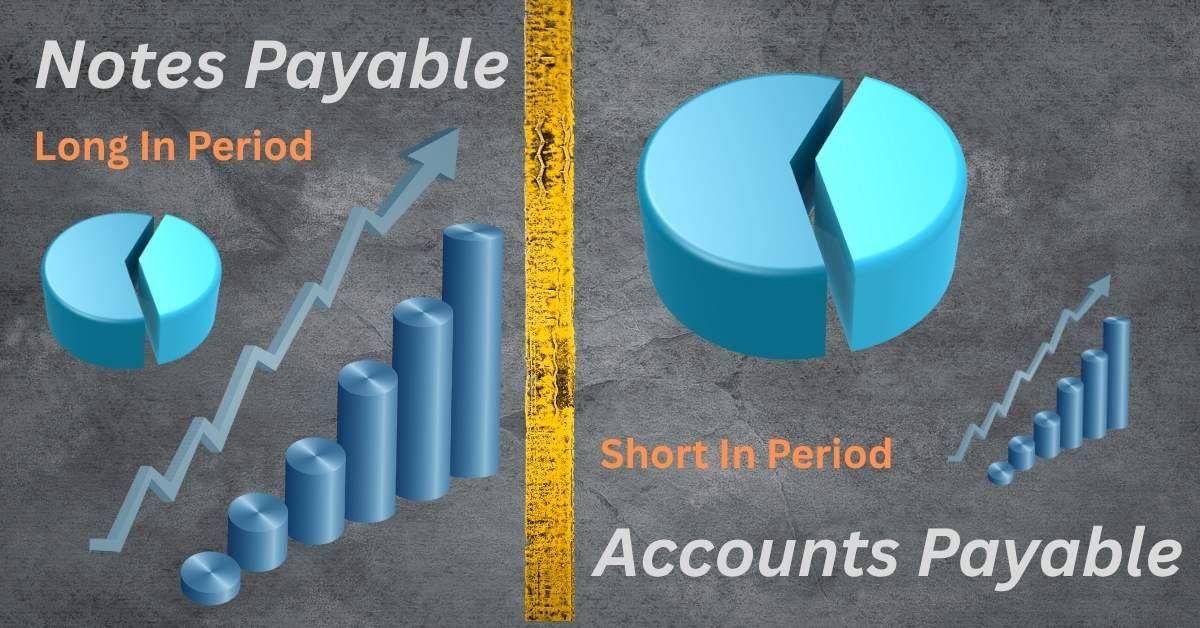
What You Should Know? Notes Payable And Accounts Payable
In the world of accounting and financial management, broadly, there are two types of liabilities, current and fixed liabilities, also known as short-term and long-term liabilities.
In this article, we will learn the difference between current liabilities, accounts payable, and notes payable. As you know, liabilities represent money owed by the business, and have different terms of origin, structure, and treatment of financial statements. Understanding the key factors of these liabilities is very crucial for effective financial planning and control.
Definition And Nature

Accounts payable show the amount of money that a company owes to vendors or suppliers for the goods and services received on credit. These are the short-term obligations of the company that are usually due within 30 to 90 days.
Accounts payable are a current liability, appearing from routine business transactions. For instance, if a business purchases raw materials on credit, it considers this transaction as an obligation and records it as accounts payable.
On the other hand, Notes payable are the formal written agreements between two parties, in which a borrower agrees to pay a specific amount of money (mentioned in the agreement) to a lender at a future date.
These agreements generally consist of terms such as interest rate, maturity date of liability, and late payment penalties. Depending upon the agreement, notes payable can be short-term or long-term liabilities. They are normally used for more crucial financial obligations or when borrowing from financial institutions.
Documentation And Formality
The main difference between accounts payable and notes payable lies in the level of formality. Accounts payable do not require any agreement for their transactions, and a simple invoice or purchase order is used for recording and documentation purposes. Usually, these transactions are informal, rely on trust, and the relationship between buyer and vendor.
In contrast to accounts payable, notes payable are formal instruments and are legal binding in the form of promissory notes or any written agreements that provide the terms of repayment. This formality makes a layer of legal obligation on notes payable, and that’s why these instruments are often considered more serious financial commitments than accounts payable.
Terms And Interest
Accounts payable do not carry interest charges if the payment is made within the period mentioned in the agreement. However, penalties or damages can be bear by the business in case of delay in payments or failure to pay the amount. Normally, vendors allow some discount offers for early payments, such as 2/10, net 30 terms, which means 2% discount is offered if the payment is made within 10 days.
In contrast to accounts payable, notes payable usually include interest as part of the agreement. The interest rate and the method of calculating the interest are precisely mentioned in the agreement. The borrower is committed to pay not only the principal amount but also the accrued interest, recorded as an expense in the book of income statement.
Recording And Presentation In Financial Statements
In accounting, accounts payable are recorded as current/short-term liabilities on the balance sheet. It represents the amount due within a short period, usually twelve months, and is part of the working capital of the business. Efficient management of accounts payable is more important for maintaining liquidity and good vendor relationships.
The recording of notes payable is much different from accounts payable, depending on the duration of the notes. Short-term notes are payable within a year and recorded as current liabilities. In contrast, long-term notes are not payable within a year and are recorded as long-term or non-current liabilities. In long-term liabilities, any interest that has accrued but not yet been paid is considered a liability.
Examples In Business
Here we get some examples in order to understand the main difference between accounts payable and notes payable. For example, a retail store buys goods from a vendor on credit, and payment is due in 30 days. This obligation of the store records that amount as accounts payable on the balance sheet under the heading of short-term liabilities on the basis of invoices it received and payment terms without any formal contract.
Now, consider a manufacturing company that needs to procure a new machine for its business growth but lacks immediate funds. The company takes a loan from the bank and signs a promissory note committing to repay the amount over 12 months with a fixed interest rate. This obligation of the company is recorded as notes payable on the company’s balance sheet under the heading of long-term Liabilities.
Implications For Cash Flow Management
Effective management of both accounts payable and notes payable is very important for maintaining the healthy cash flow of the business. Management of accounts payable includes negotiating for favorable payment terms, scheduling payments for better cash flow, and maintaining fruitful relationships with vendors. Delay in payments can damage supplier relationships and disturb operations.
Management of notes payable is a little bit more complex than accounts payable due to the involvement of interest and fixed repayment schedules. A business can face legal consequences in case of failure to meet payment obligations, and its credit rating can be damaged, and increased borrowing costs. Efficient cash flow of the business is crucial for notes payable in order to meet both interest and principal payments as scheduled.
Audit And Internal Controls
Auditors pay very deep attention to both accounts payable and notes payable during financial audits of the business. For accounts payable, the recorded liabilities are verified by matching invoices, purchase orders, and receiving reports in order to check the accuracy of liabilities. Internal controls are very important to prevent fraud and errors during the operations of the business.
On the other hand, notes payable require more scrutiny due to their formalities and financial importance. Auditors inspect the terms of the notes, verify balances of liabilities with the lenders’ records, and ensure that interest expense and accrued interest are precisely recorded. Proper documentation and following of procedures of internal control are crucial to reduce risks associated with notes payable.
Strategic Financial Planning

Understanding the main difference between accounts payable and notes payable is also crucial for strategic financial planning. Businesses may accept using accounts payable to finance routine operations without incurring interest costs.
On the other hand, Notes payable are normally used for financing capital expenditures, such as the procurement of plant or machinery, or managing cash flow during periods of expansion or downturns.
Accounts payable provides flexibility in terms of repayment and also prevents the cost of interest, while notes payable offer structured financing with certain repayment schedules of principal amount and interest. Efficient management of both types of liabilities can lead businesses to improve their capital structure, minimize the cost of capital, and increase financial stability.
Conclusion
In conclusion, although accounts payable and notes payable both show liabilities, they have many differences in terms of formality, documentation, interest, duration, and financial impact on business operations. Accounts payable are basically short-term in nature, informal, and interest-free liabilities used for routine transactions of the business.
Notes payable are formal agreements for repayment of principal along with interest. They are generally long-term obligations that are used to acquire capital assets of the business.
For all stakeholders like business owners, managers, and financial professionals, understanding these differences between accounts payable and notes payable is very important for effective financial management, reporting financial accuracy, and for good strategic decisions.
Whether managing routine operations or planning long-term investments for procurement of assets, the complete awareness and proper handling of both accounts payable and notes payable are important for a company’s financial health and operational success.
Related articles:
- Digital Marketing And Strategies: A Comprehensive Review with Practical Examples
- Are Annuities the Best Investment for a Bright Future? A Comprehensive Analysis
- Understanding Capital Expenditure: Definition, Significance, and Its Association in Financial Decision-Making
- Difference Between Accounting And Finance: A Proven Comprehensive Guide For Beginners
- Difference between Annuity due and Ordinary Annuity
- Essential Accounting Software for Small Enterprises