
Merger and Acquisition (M&A) Jobs in Corporate Finance: A Comprehensive Guide
Mergers and acquisitions (M&A) are among the most important and fascinating areas of corporate finance, which include the financial actions and choices that businesses make in order to optimize shareholder value. Corporate finance departments within operating companies offer equally compelling and more balanced career paths in Merger and Acquisition (M&A) despite the fact that investment banks frequently dominate conversations about this field.
In order to propel growth through acquisitions, divestitures, and strategic alliances, these positions integrate strategic thinking, financial analysis, and operational insight. Anyone thinking about a career in corporate finance can benefit from having a solid understanding of the Merger and Acquisition (M&A) job market.
Understanding Corporate Finance and Its Merger and Acquisition (M&A) Function
The term “corporate finance” describes the financial management operations carried out by businesses, with an emphasis on value creation projects, investment strategies, capital structure choices, and financial planning. The Merger and Acquisition (M&A) or corporate development team, which falls under this larger function, focuses on inorganic growth strategies, identifying and carrying out deals that increase the company’s capabilities, market presence, or profitability.
Corporate finance Merger and Acquisition (M&A) professionals work exclusively for their employer and have a thorough understanding of its strategy, culture, and goals, in contrast to investment bankers who advise numerous clients on a variety of transactions. They act as internal specialists who supervise post-merger integration, coordinate due diligence activities, manage relationships with outside advisors, and assess possible acquisitions. Compared to advisory roles, this insider perspective offers special benefits and unique career experiences.
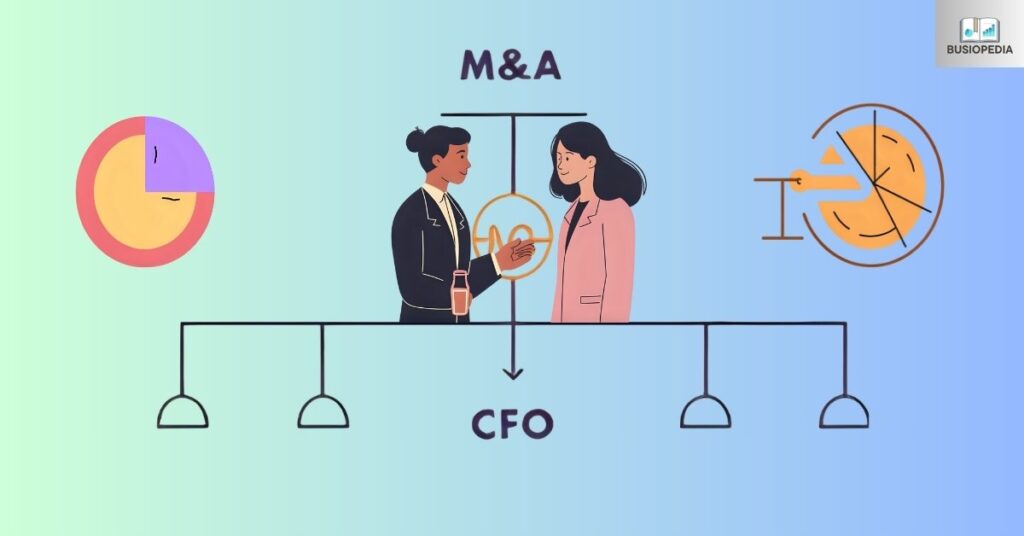
Although they may be independent departments that directly report to the CEO in businesses with very active acquisition programs, corporate finance Merger and Acquisition (M&A) teams normally report to the chief financial officer or chief strategy officer. Depending on the industry, Merger and Acquisition (M&A) activity level, and company size, these teams’ sizes and structures differ greatly. While businesses in more established industries might have smaller teams or depend more on outside advisors, technology companies and private equity portfolio firms typically maintain larger, more complex corporate development functions.
The Strategic Role of Corporate Finance Merger and Acquisition (M&A)
Corporate finance Merger and Acquisition (M&A) specialists translate top-level business goals into workable acquisition plans, acting as strategic partners to executive leadership. They need to be knowledgeable about industry trends, competitive dynamics, technological advancements, and operational capabilities in addition to financial analysis. This strategic dimension sets corporate finance Merger and Acquisition (M&A) roles apart from those that are solely focused on financial advice.
The process starts with strategy formulation, in which executives and business unit leaders collaborate with corporate development teams to find potential targets that fit with corporate goals, growth opportunities, and capability gaps. This calls for thorough market research, competitive analysis, and a strategic evaluation of the company’s future success positioning.
Target selection and screening are continuous processes that help teams keep pipelines of possible acquisition candidates full. In addition to tracking competitor movements and industry consolidation trends, they keep an eye on market developments and proactively seek out businesses that could strengthen their employer’s strategic position. A great deal of networking, relationship-building, and market awareness is necessary for this intelligence collection.
Core Responsibilities in Corporate Finance Merger and Acquisition (M&A) Roles
Corporate finance Merger and Acquisition (M&A) professionals handle a variety of tasks throughout the course of a transaction. Foundational activities include financial analysis and valuation, in which team members create intricate models to evaluate transaction economics, analyze possible synergies, and gauge target company values. To ascertain suitable valuation ranges and maximum purchase prices, they use a variety of techniques, including precedent transaction analysis, discounted cash flow analysis, and comparable company multiples.

Coordination of due diligence is a crucial duty in which corporate finance teams plan in-depth examinations of potential companies. In order to assess financial performance, contractual obligations, operational efficiency, technology infrastructure, regulatory compliance, and potential risks, they collaborate with legal counsel, accounting firms, operational consultants, and internal subject matter experts. Strong project management abilities, meticulousness, and the capacity to integrate data from various sources are necessary for overseeing this intricate process.
Finding the best transaction structures while taking tax ramifications, accounting treatment, financing strategies, and risk allocation into account is part of deal structuring and negotiation. To design transactions that optimize value while controlling risks, corporate finance Merger and Acquisition (M&A) specialists collaborate closely with tax advisors, legal counsel, and treasury teams. They engage in negotiations with sellers and their advisors, which calls for effective communication, business savvy, and the capacity to come up with win-win solutions.
One frequently overlooked component of corporate finance Merger and Acquisition (M&A) roles is internal stakeholder management. Team members are required to secure board approval, work with communications teams on announcement strategies, coordinate with human resources on integration planning, and foster consensus among business unit leaders. Relationship skills and organizational savvy are necessary for navigating internal politics and gaining support for transactions.
Planning and carrying out post-merger integration is becoming more and more part of the corporate development mandate. Many businesses assign their Merger and Acquisition (M&A) teams the responsibility of supervising the combination of operations, realization of synergies, and accomplishment of transaction objectives because they understand that successful integration is ultimately what determines the success of deals. This duty expands the role to include operational transformation in addition to deal-making.
Career Levels and Progression in Corporate Finance Merger and Acquisition (M&A)
Due to variations in business structures and requirements, corporate finance Merger and Acquisition (M&A) careers often follow structured career progression paths, albeit with greater variability than investment banking.
Analyst Level
Usually recruited from undergraduate programs with strong academic backgrounds in finance, economics, or related fields, corporate development analysts serve as entry points into the role. These experts carry out thorough financial modeling, research businesses and the industry, create presentations for upper management, assist with due diligence procedures, and keep track of deal pipelines.
Though frequently with a more sensible work-life balance and a greater emphasis on particular industries or strategic themes, the analytical rigor is comparable to that of investment banking.
Compared to their banking counterparts, analysts working in corporate finance environments are exposed to a wider range of business strategies and operations. They participate in strategic planning sessions, attend meetings with business unit leaders, and gain insight into the real workings of their employer’s operations, clients, and products. Their analytical work is enhanced, and their development of strategic thinking is accelerated by this operational context.
Associate and Senior Associate
Corporate development associates, who usually need two to four years of experience, are more independent in their assessment and implementation of deals. They might oversee the analysis of smaller deals, coordinate particular workstreams in bigger deals, manage relationships with outside advisors, and make recommendations to senior leadership.
To supplement the company’s internal knowledge, many associates bring transaction expertise and an outside perspective from their experience in investment banking or consulting.
The full management of mid-sized transactions, from the preliminary assessment to the closing and integration, is taken on by senior associates or managers. They organize cross-functional teams, lead negotiations, and act as the main points of contact with target companies. Professionals at this level must strike a balance between their ability to manage projects, build relationships, and be exceptionally analytical.
Director and Vice President
In corporate development, directors and vice presidents are in charge of junior team members, deal with private equity firms or other potential sellers, lead big deals, and work with executives to come up with a plan for mergers and acquisitions. They have strong connections, much knowledge about the industry, and a history of successfully closing deals. These experts often focus on certain types of products, types of transactions, or geographic areas, depending on what the business needs.
At this level, the job changes from being mostly analytical to being more strategic. Directors spend much time looking for new business opportunities, getting to know potential targets, advising business unit leaders on how to grow, and making strategic suggestions to boards of directors. They must strategically position their businesses and anticipate changes in the market.
Head of Corporate Development
The head of corporate development or vice president of Merger and Acquisition (M&A) is in charge of the whole function. They set the strategic direction, manage the team, keep in touch with executives, and keep an eye on all of the company’s Merger and Acquisition (M&A) activities.
For this high-level executive position, you need to have a track record of leading deals, a strategic vision, a strong executive presence, and the ability to influence people at the highest levels of the organization. At this level, pay can be as good as that of senior investment bankers, and employees can also get a share of the company’s long-term success.
Heads of corporate development are important advisors to CEOs and boards on how to grow a company without buying it, how to spend money, and how to make big changes. They negotiate with important counterparties on behalf of their companies, keep in touch with investment banks and other advisors, and are ultimately responsible for the results of mergers and acquisitions. To be successful, you need more than just knowledge of transactions; you also need to be able to make good business decisions and lead others.
Skills and Competencies for Success
To do well in corporate finance Merger and Acquisition (M&A) jobs, you need a wide range of skills, including technical knowledge, strategic thinking, and the ability to work well with others.
The foundation includes advanced Excel modeling skills, knowledge of accounting principles and how to analyze financial statements, expertise in valuation methods, and the ability to do complex scenario analysis. Professionals need to quickly create models that show how transactions work and help people make decisions when they do not know what to do.
Strategic thinking sets apart great corporate development professionals from technical analysts. This includes knowing how the competition works and how the industry is changing, spotting strategic fit and synergy potential, judging how hard it will be to integrate operations, and looking at risks and opportunities beyond just financial metrics. Not only do the best professionals think like business leaders, but they also think like financial analysts.
Communication and influence skills are very important because you need to get people inside the company to agree and work with people outside the company. Corporate development professionals need to be able to explain complicated analyses to executives who do not work in finance, write persuasive investment memos, help stakeholders with different interests have hard conversations, and negotiate well with smart business partners.
As professionals move up in their careers, project management skills become more and more important. This is because it is hard to coordinate due diligence efforts, manage multiple initiatives at the same time, drive integration processes, and meet tight deadlines while still keeping quality high.
Corporate finance Merger and Acquisition (M&A) professionals are different from outside advisors because they know a lot about business and operations. A deep understanding of their company’s products, customers, operations, and competitive position helps them better judge how well a strategy fits and how easy it will be to integrate. This necessitates an inquisitiveness regarding the business that transcends mere financial indicators.
Advantages of Corporate Finance Merger and Acquisition (M&A) Careers
There are a number of benefits to working in Merger and Acquisition (M&A) within corporate finance that are not present in investment banking or advisory roles. Work-life balance is usually more sustainable, with busy times around active transactions, but fewer extreme hours that last for a long time than in banking. This lets professionals have personal lives while still doing difficult, important work.

Strategic depth and operational exposure give us a better idea of how businesses make money in ways other than financial engineering. Corporate development professionals see deals through to integration and ultimate success or failure. This gives them a better idea of what works in practice than just theory.
Equity participation lets professionals share in the long-term value creation that comes from successful Merger and Acquisition (M&A) strategies. Base pay may be lower than in investment banking, but total pay, including equity, can be very competitive, especially at fast-growing companies or successful private equity portfolio firms.
Career progression paths often lead to broader senior leadership roles. A lot of CFOs, business unit leaders, and even CEOs have worked in corporate development before. This is because the job teaches you how to think strategically, analyze finances, and lead people from different departments.
Professionals can become real experts in their fields instead of generalists who work in a lot of different fields when they develop their industry knowledge. This specialization can lead to jobs in operations, on boards, or as an entrepreneur.
Industry Variations and Opportunities
Finance for businesses. Depending on market conditions and strategic goals, Merger and Acquisition (M&A) opportunities are very different in different industries. Tech companies have very active corporate development departments that are always looking for new ideas, talented people, and new users. These teams often make a lot of smaller purchases every year, which requires much staff and complicated procedures.
Healthcare and pharmaceutical companies do mergers and acquisitions (M&A) to get access to drug pipelines, grow their therapeutic areas, and reach a commercial scale. Because the science is so complicated, team members need to be able to look at more than just financial data. They also need to be able to look at clinical trial data, regulatory pathways, and business potential.
Industrial and manufacturing companies use Merger and Acquisition (M&A) to grow their businesses geographically, add new products to their portfolios, and vertically integrate. These deals often require much work to integrate operations and a deep understanding of how manufacturing works, how the supply chain works, and how to deal with customers.
Financial services companies do mergers and acquisitions to get bigger, move into new areas, and acquire new skills. Regulatory issues are very important in these deals, and you need to know how to get through complicated approval processes.
Private equity portfolio companies have active corporate development departments that help them make add-on acquisitions that increase the value of the platform before they sell it. These jobs give you a chance to work on many deals and focus on creating value, but only for a short time because of private equity ownership.
Conclusion
Careers in mergers and acquisitions within corporate finance are great alternatives to traditional investment banking paths because they combine in-depth financial analysis with strategic thinking, operational insight, and long-term value creation. These jobs let you make real changes in the company while also developing a wide range of skills that will help you in any business leadership role.
Corporate finance Merger and Acquisition (M&A) is an appealing and growing career path for professionals who want to do intellectually challenging work with a good work-life balance and the chance to make a real difference in the company’s strategy. The role keeps changing as companies realize that inorganic growth is key to being competitive. This opens up more and more opportunities for skilled professionals who can find, carry out, and combine transactions that create value.
Related Articles:
- Debt-to-Equity (D/E) Ratio: Financial Leverage and Capital Structure Analysis
- Depletion for Oil, Gas & Mining: Complete Guide to Natural Resource Accounting
- Intangible Assets Valuation: A Complete Guide for Modern Businesses
- What is Depreciation: 4 Common Methods to Calculate
- Marketing Mix Modeling (MMM): Complete Analysis
- How to Calculate IRR (Internal Rate of Return): Step-by-Step Guide
- How to Calculate Amortization: Step-by-Step Guide
- How to Master Real Estate Accounting for Property Development
- What is Working Capital and How to Calculate: Your Complete Guide to Financial Success
- How to Create an Amazon Seller Account: Complete Step-by-Step Guide
- Top 5 Financial Ratios Every College Student Should Know (With Examples)
- How to Register an LLC in America: A Complete Guide for Beginners, Foreigners, and Entrepreneurs
- What is Inbound Marketing: Why Smart American Businesses Are Making the Switch
- Top 5 Best Bookkeeping Software to Work with Accounting: 2025 Guide
- Remote Marketing Jobs: A Step-by-Step Guide to Opportunities and Strategies to Succeed
- What are Accounts Payable? Its Definition, Process, and Best Practices
- 10 Fundamental Accounting Principles Every Business Owner Must Know
- Fixed Index Annuities: Your Way to Financial Confidence and Security
- QuickBooks Excellence: Transform Your Accounting Game with These Powerful Techniques
- Inbound vs. Outbound Marketing: The Great Debate That’s Reshaping Business Strategy
- How to Master Balance Sheet Analysis? Expert Guide with Examples
- Income Statement Formats: Complete 2025 Guide with Examples and Structure
- What Are Current Liabilities And Why They Matter For Financial Success
- Current Assets Essentials: Elevate Your Financial Management Game
- Remote Payroll Jobs: Your Gateway to Flexibility and Financial Growth
- Payroll Advance: Powerful Ways to Enhance Workplace Morale
- Powerful Mobile Marketing Strategies You Must Try
- Best Marketing Tools In An Advertising Plan
- Mastering Revenue Expenditure for Business Success
- Market Research And Its Importance: A Comprehensive Review
- What You Should Know? Notes Payable And Accounts Payable
- Digital Marketing And Strategies: A Comprehensive Review with Examples
- Are Annuities the Best Investment for a Bright Future? A Comprehensive Analysis
- Understanding Capital Expenditure: Definition, Significance, and Its Association in Financial Decision-Making
- Difference Between Accounting And Finance: A Proven Comprehensive Guide For Beginners
- Difference between Annuity due and Ordinary Annuity
- Essential Accounting Software for Small Enterprises
- 5 Best Software For Small Business Accounting