Intangible Assets Valuation: A Complete Guide for Modern Businesses
In today’s knowledge-based economy, a company’s intangible assets are frequently its most valuable assets. Intellectual property, contractual rights, brand recognition, and competitive advantages are the sources of intangible assets’ value, as opposed to tangible assets that are measurable and touchable. Accountants, business valuators, investors, and executives who must negotiate the difficult terrain of valuing assets that exist primarily in the realm of ideas, relationships, and legal rights will find this thorough guide to the complex world of intangible asset valuation to be extremely insightful.
The importance of valuing intangible assets goes well beyond scholarly pursuits. Intangible assets like customer relationships, proprietary technology, and brand recognition account for the majority of the market value of companies like Apple, Google, and Microsoft. For these companies, financial reporting compliance, licensing negotiations, merger and acquisition activities, and strategic decision-making are all influenced by precise intangible asset valuation. Success in modern business now depends on knowing how to value these intangible but vital assets appropriately.
Understanding Intangible Assets
Non-physical resources that offer their owners financial advantages through exclusive rights, competitive advantages, or the potential to generate future cash flow are known as intangible assets. Despite their lack of physical substance, these assets have distinguishable qualities that enable measurement, identification, and legal protection. The ability of intangible assets to produce future financial gains, erect obstacles to competition, or offer operational efficiencies is what gives them their value.

Identifiability, control, and future economic benefits are among the requirements that must be met in order for intangible assets to be recognized. Identifiability is the ability of the asset to be isolated from the entity or to result from contractual rights. The ability to gain advantages and limit access for others is implied by control. Future economic benefits include the creation of income, cost reductions, or other advantages that the organization will experience.
Internally produced and externally acquired intangible assets are distinguished by accounting standards. Intangibles that are acquired externally through separate purchases or business combinations are typically recognized at acquisition cost. Because future benefits are uncertain, many development costs are expensed rather than capitalized, and internally generated intangibles are subject to stricter recognition criteria.
Categories of Intangible Assets
Intellectual Property Rights
Intellectual property gives its owners exclusive rights to works of human intellect that are legally protected. Patents, trademarks, copyrights, and trade secrets are all included in this category; each provides a unique set of protections and financial advantages.
- Patents provide exclusive rights to manufacture, use, and market the patented technology for predetermined durations, protecting innovations and inventions. While technology patents may give businesses a competitive edge in quickly changing markets, pharmaceutical patents that protect popular medications can be worth billions of dollars. Knowledge of the protected technology, market applications, remaining patent life, and competitive environment is all necessary for patent valuation.
- Trademarks and Brand Assets signs that identify products or services, are protected by trademarks and brand assets. Reputable companies like Coca-Cola, Nike, or BMW command high prices and devoted followings, which add up to substantial economic value. Brand extension potential, pricing power, market share, recognition levels, and geographic reach are all taken into account when valuing a brand.
- Software, music, art, and other original works of authorship are all protected by copyrights. Publishing houses, software developers, and entertainment companies all rely significantly on assets that are protected by copyright. Earning potential, consumer demand, rival options, and remaining protection periods are all considered in copyright valuation.

Technology and Software Assets
Intangible assets connected to technology have grown in value in the digital age. Digital platforms, databases, algorithms, and proprietary software that offer revenue-generating or competitive advantages fall under this category.
Proprietary Software: Internally created operating systems, specialized programs, and applications that offer competitive advantages or operational advantages are all considered proprietary software. Development expenses, functionality, market demand, rival options, and risks of technological obsolescence are all taken into account when valuing software.
Databases and Information Assets: Data, customer information, market research, and technical knowledge are all valuable collections found in databases and information assets. These resources facilitate decision-making, allow for targeted marketing, or offer insights. Database valuation looks at the quality, uniqueness, market relevance, and maintenance needs of the data.
Digital Platforms and Applications: Users, clients, and business partners are connected by ecosystems created by digital platforms and applications. User interaction, transaction facilitation, or advertising revenue are the ways that social media platforms, e-commerce marketplaces, and mobile applications create value. When valuing a platform, factors like network effects, monetization potential, user base size, and engagement levels are taken into account.
Customer and Market-Related Assets
Relationships, agreements, and market positions cultivated over time are the sources of value for customer and market-related intangibles. These resources offer long-term competitive advantages and are frequently hard to duplicate.
Customer relationships: They include customer lists, customer contracts, and non-contractual customer relationships, which are defined connections with particular customers or customer groups. Predictable revenue streams, lower acquisition costs, and cross-selling opportunities are all made possible by strong customer relationships. Relationship stability, profitability, growth potential, and customer retention rates are all taken into account during valuation.
Marketing-Related Assets: It includes trade names, domain names for the internet, non-compete clauses, and licensing agreements are examples of marketing-related assets. These resources help with competitive defense, brand awareness, and market positioning. Market impact, competitive significance, enforceability under the law, and strategic importance are all examined in marketing asset valuation.
Valuation Approaches for Intangible Assets
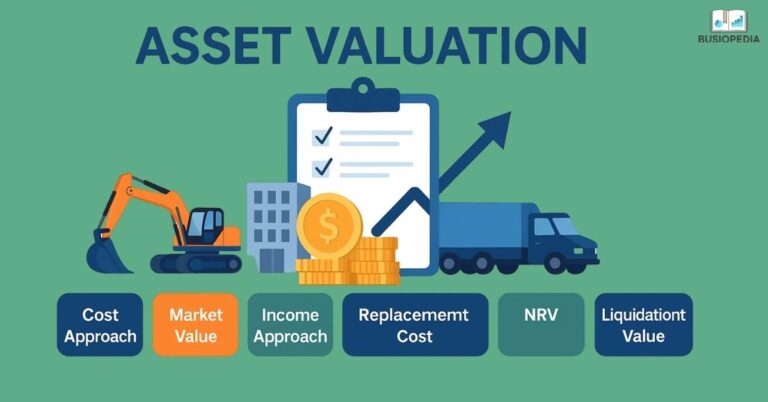
Cost Approach
Based on the cost of producing, replacing, or reproducing the asset, the cost approach calculates the value of intangible assets. This approach is effective for newly created assets or in situations where income and market data are unreliable or unavailable.
Reproduction Cost Method: This method calculates the price of producing a perfect duplicate of the current asset, taking into account all inefficiencies and out-of-date features. Development time, programmer salaries, testing costs, and project management expenditures are all included in the reproduction cost of software applications.
Replacement Cost Method: The replacement cost method calculates how much it would cost to produce an asset with comparable utility using the tools and technology available today. Modern database architecture, available development tools, and updated functionality requirements may all be taken into account in a replacement cost analysis for a legacy database system.
Worked Example – Software Development: A company developed proprietary inventory management software over 18 months using a team of 5 developers, averaging $80,000 annually, plus $200,000 in other costs. Total development cost: (5 × $80,000 × 1.5) + $200,000 = $800,000. However, using current tools and methods, equivalent software could be developed for $500,000, making the replacement cost $500,000.
The cost approach provides objectivity and clear documentation but may not reflect current market value or income-generating potential. Technological advancement can make historical costs irrelevant, while the approach may miss intangible benefits like customer relationships or market positioning.
Market Approach
By examining the prices of similar intangible assets in market transactions, the market approach establishes value. Finding genuinely comparable assets and adjusting for variations in rights, markets, timing, and other pertinent variables are necessary for this approach.
Comparable Transaction Analysis: Analyzing sales, licenses, or other transactions involving comparable intangible assets is done using the comparable transaction analysis technique. Market evidence can be found in trademark licensing agreements in similar industries, patent sales in the same technology field, or customer list acquisitions by similar businesses.
Relief-From-Royalty Method: By figuring out the present value of the royalties that would be needed to license the intangible asset from a third party, the Relief-From-Royalty Method—a popular technique—estimates value. The annual royalty savings would be $300,000 if the company makes $10 million a year and a trademark normally commands 3% royalties on net sales.
Worked Example – Trademark Valuation: A consumer products company owns a trademark for a popular beverage brand generating $50 million in annual sales. Industry royalty rates for similar trademarks range from 4-6%. Using a 5% royalty rate and 8% discount rate, assuming stable sales: Annual royalty savings = $50M × 5% = $2.5M. Capitalized value = $2.5M ÷ 8% = $31.25 million.

The Income Approach
Intangible assets are valued using the income approach according to their potential to produce future financial gains. This approach works especially well for intangible assets that generate revenue, such as patents, client relationships, and proprietary technology.
Discounted Cash Flow (DCF) Analysis: The intangible asset’s incremental cash flows are projected using this advanced technique, which then discounts them to their present value. Finding additional income, cost savings, or other advantages that are directly related to the asset is necessary for the analysis.
Multi-Period Excess Earnings Method (MPEEM): After deducting returns on all other assets used by the company, the Multi-Period Excess Earnings Method (MPEEM) separates the earnings attributable to a particular intangible asset. MPEEM is especially helpful for proprietary technology and customer relationships.
Worked Example – Patent Valuation: A pharmaceutical patent provides exclusive rights to a drug generating $100 million annual revenue with 60% gross margins and an 8-year remaining life. Incremental EBITDA = $60 million annually. Applying a 12% discount rate for pharmaceutical risk:
- Present Value Factor (8 years, 12%) = 4.9676
- Patent Value = $60M × 4.9676 = $298 million
Profit Split Method: This method divides overall company profits between intangible and tangible assets according to how each contributes. The intangible asset portion of a business’s $10 million annual revenue would be $7 million if intangible assets account for 70% of value creation.
Specialized Valuation Considerations
Technology Obsolescence and Economic Life
Technology obsolescence, shifting consumer preferences, and competitive threats pose particular risks to intangible assets. Intangible assets may lose value quickly as a result of changes in the market or advancements in technology, in contrast to tangible assets with predictable wear patterns.
Technology Risk Assessment: Technological intangibles necessitate a thorough examination of innovation cycles, competitive threats, and obsolescence risk. New technologies are always putting pressure on software applications, and patents could be rendered useless if substitute technologies appear.
Economic Life Estimation: It is necessary to balance market dynamics, technological advancements, and legal protection periods when determining the proper economic lives for intangible assets. Despite having longer copyright protection, a mobile app may only be viable for two to three years, but with the right management, a strong brand can last forever.
Regulatory and Legal Factors
Values of intangible assets are greatly impacted by the strength of legal protection, regulatory compliance, and enforceability. Overnight changes in laws, rules, or court rulings can significantly impact asset values.
Legal Protection Analysis: Trade secret protection measures, copyright compliance, trademark registrations, and patent strength all have a direct impact on asset values. Risk is raised, and weak or contested intellectual property rights decrease economic value.
Regulatory Environment: Intangible asset values are influenced by government policies, international trade agreements, and industry regulations. While technology assets need to adhere to privacy and data protection laws, pharmaceutical patents are subject to regulatory approval risks.

Industry-Specific Applications
Technology Sector
Intangible assets, such as user data, algorithms, proprietary software, and platform effects, usually account for the majority of the value of technology companies. Network effects, user engagement metrics, and competitive moats must all be understood for valuation.
Software and Platform Valuation: Technology platforms benefit from network effects where value increases with user adoption. Social media platforms, operating systems, and marketplace applications exhibit these characteristics, requiring specialized valuation approaches considering user growth, engagement levels, and monetization potential.
Data Asset Valuation: User data, behavioral analytics, and machine learning models create significant value for technology companies. Data valuation considers quality, uniqueness, regulatory compliance, and monetization potential while addressing privacy concerns and regulatory restrictions.
Pharmaceutical and Biotechnology
Pharmaceutical firms make significant investments in R&D, building up valuable patent portfolios that safeguard new drug discoveries. Clinical trial results, patent challenges, and regulatory approval procedures pose particular risks to these assets.
Drug Patent Valuation: Specialized analysis of clinical trial data, the likelihood of regulatory approval, market size estimation, and competitive landscape assessment are all necessary for pharmaceutical patents. Market penetration rates, patent cliff timing, and peak sales forecasts all have a big influence on valuations.
Research and Development Assets: Although they face lengthy development timelines and high failure rates, early-stage drug candidates and research programs hold promise for the future. Option-based methods and risk-adjusted probability analysis are necessary for valuation.
Consumer Brands and Retail
Consumer-focused businesses create value through market positioning, customer loyalty, and brand recognition. These resources enable brand extensions, lower marketing expenses, and give pricing power.
Brand Valuation Methodologies: Reputable consumer brands command high prices and devoted followings. In addition to taking market trends and competitive threats into account, brand valuation looks at market share, price premiums, customer loyalty metrics, and the potential for brand extension.
Customer Loyalty Programs: Loyalty programs generate behavioral data and valuable customer relationships. When evaluating competitive advantages, valuation takes into account program costs, incremental spending, member engagement, and redemption trends.

Valuation Process and Best Practices
Planning and Scoping
A thorough asset identification process and a precise objective definition are prerequisites for effective intangible asset valuation. Documentation standards, accuracy requirements, and method selection are all influenced by the valuation purpose.
Asset Identification and Documentation: Legal registrations, development records, maintenance expenses, and performance indicators are all included in thorough inventories of intangible assets. Portfolios of intangible assets and their attributes can be tracked with the aid of digital asset management systems.
Valuation Standards and Guidelines: Organizations such as the International Valuation Standards Council (IVSC) and the American Society of Appraisers (ASA) offer professional valuation standards that offer guidance on reporting standards, documentation requirements, and methodology selection.
Data Gathering and Analysis
A variety of data sources, such as financial records, market research, legal documents, and technical specifications, are needed for intangible asset valuation. Credibility and reliability of valuation are directly impacted by data quality.
Financial Performance Analysis: The contribution of assets to business performance can be established with the use of historical financial data. The basis for income-based valuations is provided by revenue attribution, cost analysis, and profitability measurement.
Market Research and Benchmarking: Method selection is supported by research on market trends, industry analysis, and competitive evaluation, which also supplies data for valuation assumptions. Transaction records, royalty rate databases, and industry reports provide valuable market evidence.
Valuation Execution and Quality Control
Professional intangible asset valuations necessitate thorough quality control procedures and the application of a systematic methodology. Several methods improve result reliability and offer cross-verification.
Methodology Application: It is necessary to comprehend the advantages, disadvantages, and suitable use cases of each approach in order to apply the methodology correctly. The choice of approach should be in line with the goals of valuation, the data at hand, and the attributes of the asset.
Sensitivity and Scenario Analysis: Critical variables and uncertainty ranges are identified through sensitivity analysis and key assumption testing. Scenario analysis looks at various future events and how they affect asset values.

Challenges and Emerging Trends For Intangible Assets
Valuation Challenges
The invisibility of assets, the lack of market data, and the speed at which technology is developing present particular difficulties for intangible asset valuation. These problems call for specific knowledge and creative solutions.
Data Availability and Quality: Intangible asset valuation is made more difficult by restricted market transactions and restrictions on proprietary information. Businesses might be reluctant to divulge specifics about their most valuable assets, which would limit the opportunities for benchmarking.
Technological Disruption: Valuable intangible assets can be quickly rendered obsolete by rapid technological advancement. Blockchain technology, artificial intelligence, and other innovations both threaten and open up new opportunities.
Artificial Intelligence and Machine Learning
Through automated analysis, pattern recognition, and predictive modeling, artificial intelligence (AI) and machine learning technologies are revolutionizing the valuation of intangible assets.
Automated Valuation Models: Platforms with AI capabilities examine sizable datasets to find trends in valuation and produce rough estimates. Standardized intangibles with copious amounts of market data especially benefit from these tools.
Predictive Analytics: Machine learning algorithms forecast market shifts, competitive threats, and technological trends that impact the value of intangible assets. Investment priorities and the best time to license are determined with the aid of predictive models.
Digital Assets and Cryptocurrencies
With the rise of digital assets, cryptocurrencies, and NFTs, new types of intangible assets have emerged that call for specific methods of valuation.
Digital Token Valuation: Network effects, utility functions, and market dynamics must all be taken into account when valuing cryptocurrencies and utility tokens. For these special assets, traditional methods need to be modified.
NFT and Digital Art Valuation: Digital art and non-fungible tokens are examples of new intellectual property that call for creative valuation strategies that take market sentiment, artistic merit, and scarcity into account.
Key Takeaways
- Method Selection Is Crucial: Select valuation techniques according to the intended use, available data, and asset characteristics. Market approaches are appropriate for assets with active licensing markets, whereas income approaches are best suited for assets that generate cash.
- Evaluation of Economic Life Is Essential: It is necessary to balance market dynamics, technological cycles, and legal protection periods in order to estimate economic lives accurately. More often than not, conservative estimates turn out to be more accurate than optimistic ones.
- Value Is Driven by Risk Assessment: Intangible asset values are greatly impacted by regulatory changes, competitive threats, and technological obsolescence. Adjustments to probability and discount rates should be based on thorough risk analysis.
- Documentation Standards Are Important: Keep thorough records of all calculations, assumptions, and methods. Future valuations, regulatory compliance, and audit requirements are all supported by professional documentation.
- The Value of Market Intelligence: Keep up with developments in technology, industry trends, and laws that impact the value of intangible assets. Market expertise improves method selection and assumption reliability.
- Credibility Is Added by Professional Experience: Experts in industry analysis, technology evaluation, and intellectual property law are beneficial for complex valuations. Their knowledge guarantees precise evaluations and adherence to regulations.
- Various Methods Provide Validation: Cross-verification and confidence in results are provided by using multiple validation techniques. Considerable differences between approaches call for research and justification.
- Frequent Updates Retain Relevance: The value of intangible assets fluctuates quickly as a result of market changes, competitive dynamics, and technological advancements. Set up regular revaluation schedules for important assets.
- Legal Protection Affects Value: While inadequate protection diminishes economic benefits, robust intellectual property rights raise asset values. Maintaining and improving protection levels is aided by routine legal reviews.
- Combining Business Strategy With Integration: Align the value of intangible assets with investment priorities and business strategy. Instead of existing as stand-alone tasks, valuations ought to assist in decision-making.
Conclusion
One of the most difficult and important problems in contemporary business valuation practice is the valuation of intangible assets. Accurately evaluating and managing intangible assets is crucial for business success as economies move more and more toward knowledge-based value creation. The techniques covered in this extensive guide offer the groundwork for trustworthy valuation practices, and the particular considerations deal with the difficulties presented by various asset classes and industry settings.
When it comes to intangible assets, the three main valuation methodologies—cost, market, and income—each have unique benefits and drawbacks. The cost approach may overlook market dynamics and revenue potential, but it offers objectivity and transparent documentation. The market approach uses comparable analysis to present the current state of the economy, but it necessitates careful adjustment for asset differences. Although it requires complex forecasting and risk assessment, the income approach captures the fundamental value-creating potential.
The valuation of intangible assets in the modern era faces previously unheard-of difficulties, such as market volatility, regulatory change, and rapid technological advancement. The rise of digital assets, artificial intelligence, and new types of intellectual property necessitates ongoing innovation and adaptation of conventional techniques. Combining technological prowess with in-depth knowledge of the market, professional judgment, and deep expertise is essential for success.
Accurate intangible asset valuation has real-world applications in all facets of contemporary corporate operations. Reliable value assessments are essential for making strategic decisions about acquisition targets, R&D investments, and licensing agreements. Risk management, tax planning, and financial reporting compliance all call for a deep comprehension of the values of intangible assets and the factors that influence them.
As technology develops and business models change, intangible asset valuation will also continue to change. Improved accuracy and efficiency are anticipated through the combination of automated valuation tools, predictive analytics, and artificial intelligence. The essential requirement for professional knowledge, moral principles, and exacting methodology application, however, has not changed.
The best-positioned companies to take advantage of the opportunities presented by the knowledge economy will be those that make investments in thorough intangible asset valuation capabilities, keep up-to-date market intelligence, and cultivate specialized expertise. To realize their full potential and facilitate well-informed decision-making in a business environment that is becoming more complex, the invisible assets that propel modern business success need to be valued using visible, expert, and sophisticated methods.
Related Articles:
- What is Depreciation: 4 Common Methods to Calculate
- Marketing Mix Modeling (MMM): Complete Analysis
- How to Calculate IRR (Internal Rate of Return): Step-by-Step Guide
- How to Calculate Amortization: Step-by-Step Guide
- How to Master Real Estate Accounting for Property Development
- What is Working Capital and How to Calculate: Your Complete Guide to Financial Success
- How to Create an Amazon Seller Account: Complete Step-by-Step Guide
- Top 5 Financial Ratios Every College Student Should Know (With Examples)
- How to Register an LLC in America: A Complete Guide for Beginners, Foreigners, and Entrepreneurs
- What is Inbound Marketing: Why Smart American Businesses Are Making the Switch
- Top 5 Best Bookkeeping Software to Work with Accounting: 2025 Guide
- Remote Marketing Jobs: A Step-by-Step Guide to Opportunities and Strategies to Succeed
- What are Accounts Payable? Its Definition, Process, and Best Practices
- 10 Fundamental Accounting Principles Every Business Owner Must Know
- Fixed Index Annuities: Your Way to Financial Confidence and Security
- QuickBooks Excellence: Transform Your Accounting Game with These Powerful Techniques
- Inbound vs. Outbound Marketing: The Great Debate That’s Reshaping Business Strategy
- How to Master Balance Sheet Analysis? Expert Guide with Examples
- Income Statement Formats: Complete 2025 Guide with Examples and Structure
- What Are Current Liabilities And Why They Matter For Financial Success
- Current Assets Essentials: Elevate Your Financial Management Game
- Remote Payroll Jobs: Your Gateway to Flexibility and Financial Growth
- Payroll Advance: Powerful Ways to Enhance Workplace Morale
- Powerful Mobile Marketing Strategies You Must Try
- Best Marketing Tools In An Advertising Plan
- Mastering Revenue Expenditure for Business Success
- Market Research And Its Importance: A Comprehensive Review
- What You Should Know? Notes Payable And Accounts Payable
- Digital Marketing And Strategies: A Comprehensive Review with Examples
- Are Annuities the Best Investment for a Bright Future? A Comprehensive Analysis
- Understanding Capital Expenditure: Definition, Significance, and Its Association in Financial Decision-Making
- Difference Between Accounting And Finance: A Proven Comprehensive Guide For Beginners
- Difference between Annuity due and Ordinary Annuity
- Essential Accounting Software for Small Enterprises
- 5 Best Software For Small Business Accounting