
Mastering Revenue Expenditure for Business Success
Revenue Expenditure is a basic concept in the financial management of both the private and public sectors. It shows the costs consumed in routine operations of the business or government for the sustainability of key operations and revenue generation. Basically, these expenses are recurring in nature and are usually consumed in one accounting period.
These expenses are not used to acquire long-term assets for the business or government. To understand the concept of revenue expenditure is most important for financial planning, budgeting, and the evaluation of the financial health of a business or government.
Definition of Revenue Expenditure

Revenue Expenditures are normally referred to as operating expenses, which means these are incurred to meet to day operations of the business or government. These expenses are directly recorded in the income statement in the period in which they are consumed. Salaries of employees, repairs and maintenance of assets, rents of buildings and stores, costs of utilities used in the current accounting period, and purchasing of raw materials are examples of revenue expenditures.
As opposed to capital expenditure, where investment is for long-term assets like buildings or equipment in order to get benefits beyond one accounting period, revenue expenditures do not give any benefit beyond the current accounting period. Understanding this difference between these two concepts is crucial because it shows how expenses are incurred, recorded, and reported in financial statements.
Importance of Revenue Expenditure
Revenue expenditure plays a leading role in business operations, and its importance can be accentuated in the following ways:
- Operational Efficiency: Provision of necessary resources in order to ensure smooth, regular operations, and to focus on increasing overall operational efficiency of the business.
- Profit Calculation: Accurate and fair recording of revenue and expenditures is essential for getting the true picture of profit and loss of an organization.
- Budgeting and Forecasting: These are the main factors that help in determining realistic budgets and financial anticipation for sustainability in future competition.
- Cost Control: Monitoring and controlling revenue expenditures assist in managing costs and improving the profitability of the business.
- Tax Implications: Revenue expenditures are deductible for tax purposes, which means reducing taxable income.
Characteristics of Revenue Expenditure
The following are the characteristics of Revenue expenditures:
- Recurring Nature: These expenses occur on a daily basis to meet operational requirements of the business.
- Short-Term Benefit: Because these expenses occur on a daily basis to meet day-to-day business requirements so these benefits are also limited to that financial year.
- Charged to Profit and Loss Account: Revenue expenditures are routine expenses in nature, so these are not capitalized. These are deducted from revenue to get the net profit or loss.
- No Creation of Assets: In contrasted to capital expenditure, where expenditures are capitalized because of acquiring new assets, revenue expenditure is not used to acquire any fixed asset, so these are also not capitalized.
- Essential for Operations: These expenses are essential to maintain the routine operation of the business in order to get optimal productivity of an organization.
Types of Revenue Expenditure
Depending on their utilization, these expenditures are divided into several types:
- Direct Expenses: These include the salaries of workers, the cost of fuel utilized, and raw materials directly involved in primary production functions (production of goods and services).
- Indirect Expenses: Indirect expenses include the office’s rent, administrative staff salaries, advertising costs, and other costs associated with selling the products, distributing, and administering a business.
- Maintenance and Repairs: These are the costs used for routine maintenance of machines and equipment used in the production of products, and their understanding is essential for the efficient operations of the business.
- Utilities and Supplies: These are general expenses used in the production of goods and services, including the price of water, electricity bills, internet fees, and the cost of office supplies.
- Depreciation and Amortization: Due to the fact that assets help to generate the income for that accounting period, these non-cash expenses are considered as revenue expenditures. Intangible assets fall under amortization, while tangible assets fall under depreciation.
Examples of Revenue Expenditure
To get a better understanding of this concept, here are some examples in a business context:
- Salaries and wages of employees
- Utility bills, such as electricity and water
- Rent for office or factory.
- Scheduled repairs and maintenance of machinery
- Purchasing of inventory and raw materials for production
- Cost of Advertising and marketing
- Insurance premium
Revenue Expenditure in Government Accounting
In the light of public finance, revenue expenditure refers to that expenditure incurred by the government for its day-to-day performing activities and for rendering public services. These expenditures do not help in the acquisition of assets and are financed through revenue such as taxes and other incomes of the government.
The following are the major examples of these expenditure in respect of government accounting:
- Government employees’ salary
- Interest paid on public debt
- Provision of Subsidies and Welfare Schemes
- Defense expenditures
- Pensions expenditures
Government revenue expenditure is a main component of the fiscal policy and is accurately monitored to keep a balance between developmental and non-developmental spending.
Difference Between Revenue and Capital Expenditure
To know about the difference between revenue and capital expenditure is crucial for financial reporting and forecasting analysis:
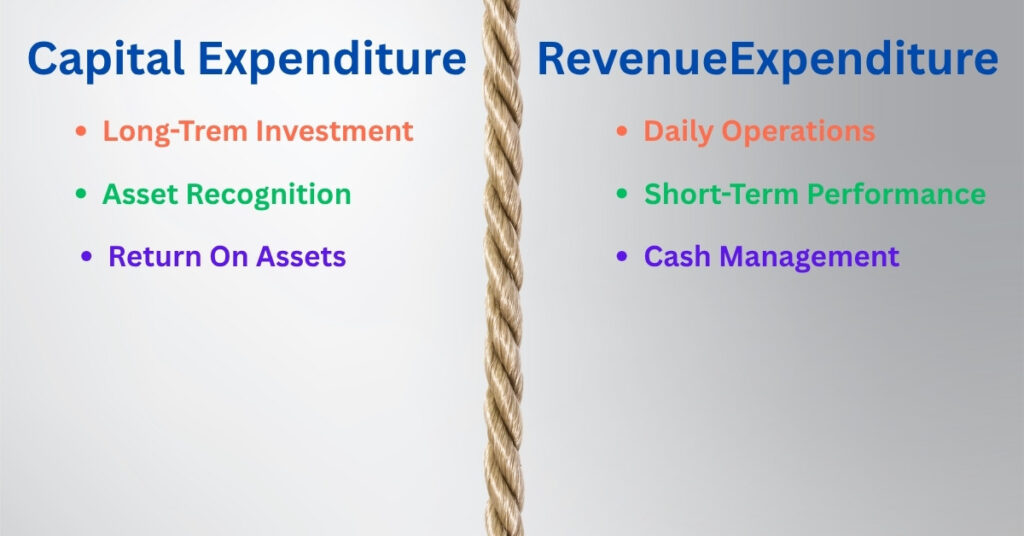
- Revenue expenditures are recurring in nature, which means they are incurred repeatedly in one accounting period to run the business, while capital expenditures are non-recurring in nature, which means they are not incurred in routine, but usually incurred to acquire long-term assets.
- Revenue expenditures are short-term expenses, while capital expenditures are long-term expenses.
- Revenue expenditures are charged to the income statement for calculating the profit and loss of the company. Still, capital expenditures are capitalized in the balance sheet under the heading of long-term assets and depreciated over their useful lives.
- Revenue expenditures are not used to create or acquire assets, whereas capital expenditures are used to acquire new assets in the business.
- Salaries of employees, rent, and utilities are examples of revenue expenditures, and the acquisition of machinery and construction of buildings are examples of capital expenditures.
Effects on Financial Statements
Revenue expenditures directly impact the income statement of a business. As long as these are recurring and compulsory for operations, they minimize the net income when recorded.
Fair classification and precise recording of both revenue and capital expenditures are crucial for financial liquidity and regulatory compliance.
Unfair classification of capital expenditure or revenue expenditure may result in ambiguous financial statements, affecting the decision-making power of stakeholders.
Revenue Expenditure Control and Optimization
Effective management of revenue expenditure is necessary for keeping profitability and ensuring the financial sustainability of the business.
The following are some key strategies for the optimization of revenue expenditure:
Budgetary Control: Allocating a budget for each activity and observing actual expenses against each helps in reducing the consumption of additional costs.
Cost-Benefit Analysis: Evaluating each cost’s actual output against desired result to improve the efficiency of each expenditure.
Process Automation: In order to reduce the costs of manual efforts, improve the automation in potential areas of production.
Vendor Management: Good communication is the best tool while negotiating with suppliers and service providers for the implementation of better terms.
Regular Audits: Audit is not just the monitoring of financial records, but it’s a process of detecting, identifying, and rectifying inefficiencies. Conducting scheduled financial audits helps in summarizing fair financial statements to all stakeholders.
Challenges in Managing Revenue Expenditure
Organizations usually face some challenges while managing revenue and expenditures:
- Identification of essential and non-essential expenses
- Avoiding cost penetrates
- Keeping up with inflation and increasing operational costs
- Following the accounting standards
- Keeping a balance between cost reduction and operational effectiveness
Conclusion
Revenue expenditure is an indispensable part of any organization’s financial system. Whether in a corporate or governmental climate, it shows the lifeblood that maintains daily operations running. As long as these expenses may not create an asset, their effective management and control are very important for preserving operations, ensuring profitability, and gaining long-term goals.
Identifying, understanding, categorizing, and monitoring revenue expenditures may lead organizations to make well-informed decisions, wisely allocation of resources, and survive financially healthy.
Related Articles:
- Market Research And Its Importance: A Comprehensive Review
- What You Should Know? Notes Payable And Accounts Payable
- Digital Marketing And Strategies: A Comprehensive Review with Practical Examples
- Are Annuities the Best Investment for a Bright Future? A Comprehensive Analysis
- Understanding Capital Expenditure: Definition, Significance, and Its Association in Financial Decision-Making
- Difference Between Accounting And Finance: A Proven Comprehensive Guide For Beginners
- Difference between Annuity due and Ordinary Annuity
- Essential Accounting Software for Small Enterprises