

Depletion for Oil, Gas & Mining: Complete Guide to Natural Resource Accounting
If you’re in the natural resources industry—whether you’re mining coal in Wyoming, pumping oil in Texas, or harvesting timber in Oregon—you’ve probably heard the term “depletion” thrown around. But what exactly is it, and why should you care? Let’s break down this essential accounting concept in plain English.
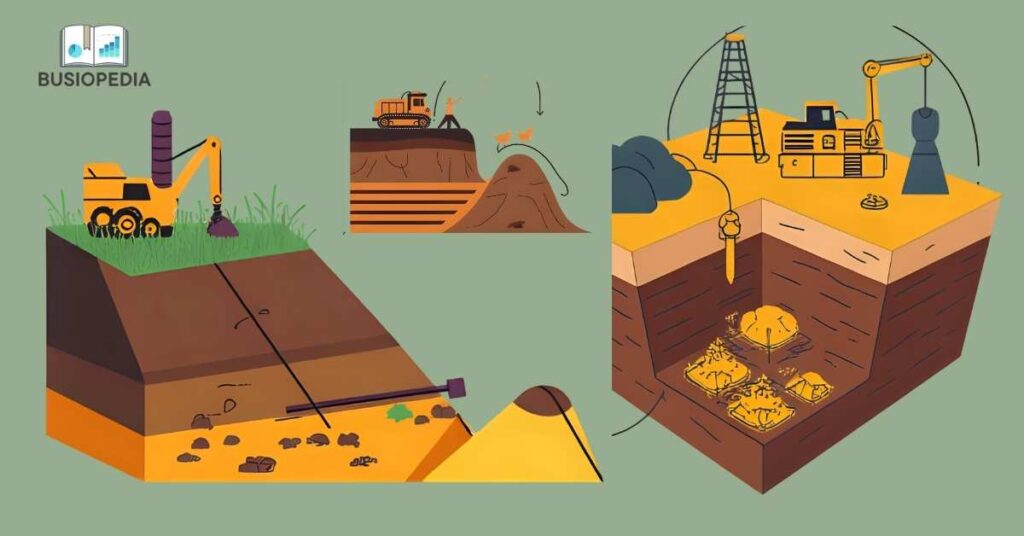
Think of depletion as depreciation’s rugged cousin. At the same time, depreciation handles your factory equipment and office buildings, depletion deals with something entirely different: the earth’s natural resources. We’re talking about oil reserves, mineral deposits, natural gas fields, timber stands, and gravel quarries. These aren’t assets you can replace with a purchase order—once you extract them, they’re gone forever.
What Exactly Is Depletion?
Here’s the deal: when your company owns or has rights to extract natural resources, you’re essentially buying inventory that’s still in the ground. Whether you paid $10 million for mining rights or $50 million for an oil field, that upfront cost needs to be matched against the revenue you’ll earn as you extract and sell those resources. That’s where depletion comes in.
Depletion is the systematic allocation of the cost of natural resources over the period you extract them. It’s an accounting method that helps you match expenses with revenues—a fundamental principle that keeps your financial statements accurate and meaningful. Without proper depletion accounting, your profits would look artificially high in the early years (since you’re not recognizing the cost of the resources you’re selling) and your balance sheet would overstate the value of depleted reserves.
The IRS takes it seriously, too. They allow two methods for calculating depletion deductions on your tax return: cost depletion and percentage depletion. We’ll dive into both, but here’s the key point—you can often choose the method that gives you the larger deduction each year. That’s right, the tax code actually gives you options that could save your company serious money.
Cost Depletion: The Basic Method
Cost depletion works similarly to units-of-production depreciation. You’re spreading the cost of your natural resource based on how much you actually extract each year. It’s straightforward, objective, and accepted by both GAAP (Generally Accepted Accounting Principles) and the IRS.
Here’s the formula that makes it work:
Depletion per Unit = (Total Cost – Salvage Value) ÷ Total Estimated Recoverable Units
Once you have your per-unit rate, calculating annual depletion is simple:
Annual Depletion Expense = Depletion per Unit × Units Extracted During the Year
Let me show you how this works with a real-world example. Say your company purchases mineral rights to a copper mine in Arizona for $5 million. Geological surveys estimate the mine contains 2 million tons of recoverable copper ore. Your company plans to restore the land after extraction, which will cost about $200,000, but you estimate the land will be worth $300,000 afterward, giving you a net salvage value of $100,000.
Setting Up Your Depletion Calculation:
- Total cost basis: $5,000,000
- Estimated recoverable tons: 2,000,000
- Salvage value: $100,000
- Depletable base: $5,000,000 – $100,000 = $4,900,000
Depletion rate per ton = $4,900,000 ÷ 2,000,000 = $2.45 per ton
Now, let’s say in Year 1, your operation extracts 150,000 tons of copper ore:
Year 1 Depletion Expense = 150,000 tons × $2.45 = $367,500
Your journal entry would look like this:
Dr. Depletion Expense $367,500
Cr. Accumulated Depletion $367,500
After Year 1, your balance sheet shows:
- Mineral rights (at cost): $5,000,000
- Less accumulated depletion: ($367,500)
- Net book value: $4,632,500

The Moving Target: Revising Your Estimates
Here’s where it gets interesting. Natural resource extraction isn’t an exact science. As you dig deeper, drill further, or log more acres, you’ll learn more about what you actually have. Maybe that copper mine you thought held 2 million tons actually contains 2.5 million tons based on new geological surveys. Technological advances make previously uneconomical deposits worth extracting.
When your estimates change, you don’t go back and restate prior years. Instead, you adjust going forward—it’s called a “change in accounting estimate” in accounting-speak. You recalculate your depletion rate using the remaining cost basis divided by the remaining recoverable units.
Let’s continue our copper mine example. After Year 1, you’ve extracted 150,000 tons and have a remaining cost basis of $4,532,500 ($4,900,000 original base minus $367,500 depletion taken). New surveys now estimate 2,300,000 tons remain in the ground (not the original estimate of 1,850,000).
Revised depletion rate = $4,532,500 ÷ 2,300,000 tons = $1.97 per ton
If you extract 200,000 tons in Year 2:
Year 2 Depletion Expense = 200,000 × $1.97 = $394,000
This approach keeps your accounting responsive to real-world conditions without the nightmare of restating old financial statements.
Percentage Depletion: The Tax Break You Should Know About
Now, here’s where things get really interesting for your tax planning. The IRS allows an alternative called percentage depletion, and it can be incredibly valuable. Unlike cost depletion, percentage depletion isn’t based on your actual cost—it’s based on your gross income from the property.
Congress created percentage depletion as an incentive to encourage natural resource development in the United States. The theory? These operations are risky, capital-intensive, and economically important, so they deserve favorable tax treatment.
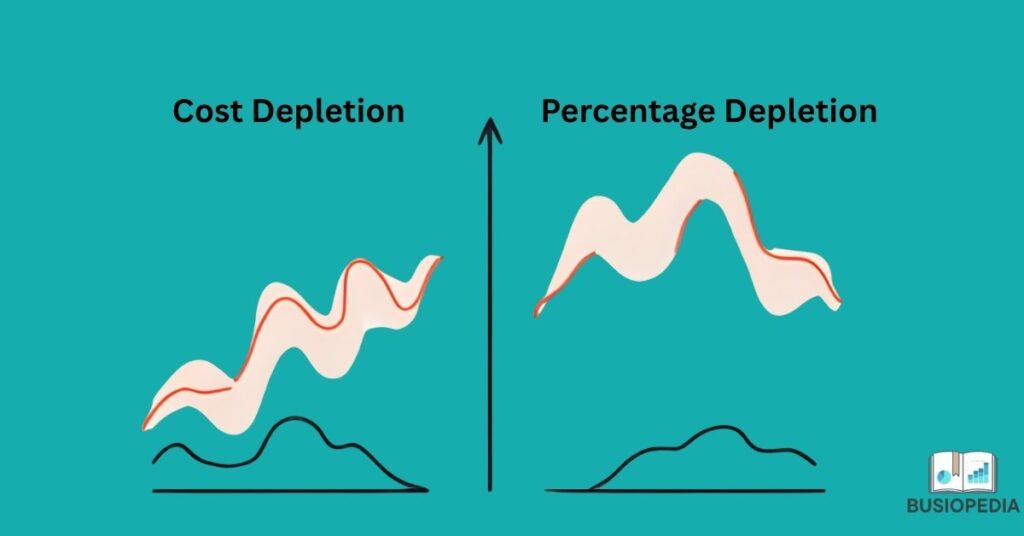
Here’s how percentage depletion works: you apply a fixed percentage (set by the tax code) to your gross income from the property. Different resources get different percentages:
- 15%: Oil and gas wells (with limitations for major producers)
- 14%: Metal ores (gold, silver, copper, iron, uranium)
- 10%: Coal, lignite
- 5%: Sand, gravel, stone, certain clays
- 22%: Sulfur, uranium (if from U.S. deposits)
There’s one important limitation: percentage depletion generally can’t exceed 50% of your taxable income from the property (100% for oil and gas). But here’s the kicker—you can claim percentage depletion even after you’ve fully recovered your cost basis. That’s right, you could theoretically claim depletion deductions exceeding your original investment.
Example: Oil and Gas Percentage Depletion
Your company operates a small oil well in Oklahoma that generates $800,000 in gross revenue during the year. Your production costs are $450,000, giving you taxable income of $350,000 from the property.
Percentage depletion calculation:
- Gross income: $800,000
- Percentage depletion rate for oil: 15%
- Tentative depletion: $800,000 × 15% = $120,000
50% of taxable income limitation:
- Taxable income before depletion: $350,000
- 50% limit: $350,000 × 50% = $175,000
Since $120,000 is less than $175,000, you can claim the full $120,000 as your depletion deduction.
Now, let’s say your cost depletion for the year would only be $85,000. Which do you choose? Easy—you take percentage depletion because it’s higher. The IRS lets you make this choice every single year, so you’re always maximizing your deduction.
Financial Reporting vs. Tax Reporting: Playing Both Games
Here’s something that trips up a lot of people: what you report in your financial statements doesn’t have to match what you report on your tax return. For financial reporting under GAAP, you must use cost depletion—it’s the only method accepted. But for your tax return, you get to choose between cost depletion and percentage depletion each year.
This creates a timing difference between your book income and taxable income, which means you’ll need to account for deferred taxes. When percentage depletion exceeds cost depletion (which it often does), you’re deferring tax liability to future periods.
Practical Example of the Book-Tax Difference:
Your timber company’s cost depletion for the year is $200,000, which you record in your financial statements. However, for tax purposes, percentage depletion gives you a $280,000 deduction.
Financial Statement (GAAP):
- Depletion expense: $200,000
- This reduces book income by $200,000
Tax Return:
- Depletion deduction: $280,000
- This reduces taxable income by $280,000
The $80,000 difference ($280,000 – $200,000) means you’re paying less tax now than your financial statements suggest you should. You’ll need to record a deferred tax liability to account for this temporary difference.
Industry-Specific Considerations
Different natural resource industries face unique depletion challenges. Let’s look at how depletion works across various sectors you might be involved in.
Oil and Gas: Complex but Rewarding
The oil and gas industry deals with some of the most complex depletion scenarios. You’re not just dealing with simple extraction—you’ve got primary production, secondary recovery, enhanced oil recovery, and constantly changing reserve estimates based on new drilling data.
Major integrated oil companies (the “Big Oil” players) face restrictions on percentage depletion, but independent producers and royalty owners can usually claim it. If your company produces less than an average of 1,000 barrels per day, you likely qualify for percentage depletion on your first 1,000 barrels of daily production.
Mining: From Coal to Precious Metals
Mining operations deal with ore grades, waste rock ratios, and processing costs that affect what’s economically recoverable. Your depletion calculation needs to account for proven and probable reserves, and as you mentioned earlier, these estimates change as you learn more about your deposit.
For metals like gold, silver, and copper, the 14% percentage depletion rate can provide significant tax benefits, especially when commodity prices are high. But remember, you need to recalculate your cost depletion rate whenever your reserve estimates change significantly.
Timber: Thinking Long-Term
Timber operations face unique challenges because trees grow. You might purchase timberland, wait 20-30 years for trees to mature, then harvest. Depletion applies when you cut and sell the timber, based on the total timber volume available.
Many timber companies use cruising reports (professional surveys of timber stands) to estimate board feet available. As trees grow, your total recoverable units actually increase, which can lower your depletion rate per unit.
Quarries and Aggregates: The Building Blocks
Sand, gravel, and stone operations might seem simple, but they face their own complications. Determining total recoverable units requires detailed surveying and understanding of the deposit’s depth and quality. Plus, zoning restrictions and environmental regulations limit how much you can actually extract, even if more material exists.
Common Mistakes to Avoid
After working with dozens of natural resource companies, I’ve seen certain mistakes pop up repeatedly. Let’s make sure you don’t fall into these traps:
- Forgetting to Update Reserve Estimates. Too many companies calculate their depletion rate once and never revisit it. Your estimates will change—guaranteed. Set up an annual process to review and update your reserve estimates with input from engineers, geologists, or foresters.
- Not Comparing Cost vs. Percentage Depletion. Some companies get comfortable with one method and stick with it. You should calculate both cost depletion and percentage depletion every single year and choose the higher amount for your tax return. This simple step could save you thousands or even millions in taxes.
- Improper Cost Capitalization Make sure you’re including all the right costs in your depletion base: acquisition costs, geological surveys, drilling or mining development costs, and site preparation. But don’t include ongoing extraction costs—those are period expenses, not capital costs subject to depletion.
- Ignoring Salvage Value. Don’t forget to subtract any expected salvage value from your depletion base. If you’ll be able to sell the land for farming or development after extraction, or if equipment and infrastructure have residual value, these amounts reduce your depletable base.
Setting Up Your Depletion Accounting System
Whether you’re running a small mining operation or managing assets for a larger company, you need systems that track depletion accurately. Here’s what your accounting setup should include:
Asset Register: Maintain detailed records for each property, including acquisition date, cost, estimated reserves, depletion method used, and accumulated depletion to date.
Production Records: Track units extracted by property, month by month. You’ll need this for calculating both cost depletion and verifying percentage depletion calculations.
Reserve Reports: Keep engineering reports, geological surveys, and other documentation supporting your reserve estimates. These are crucial for IRS audits and for updating your depletion calculations.
Depletion Worksheets: Create templates that calculate your depletion rate, annual depletion expense, and revised rates when estimates change. Spreadsheets work fine for small operations, but larger companies should consider specialized software.
The Bottom Line: Why Depletion Matters
Depletion isn’t just an accounting formality—it has a real financial impact. Proper depletion accounting ensures your financial statements accurately reflect the consumption of your natural resource assets. It matches your expenses with the revenues those resources generate, giving investors, lenders, and management a true picture of profitability.
On the tax side, depletion deductions can significantly reduce your tax liability. For capital-intensive industries like mining and oil, and gas, depletion deductions represent one of your largest tax benefits. The difference between cost depletion and percentage depletion could save your company 5-15% on taxes in any given year.
Key Takeaways
- Master Both Methods: Understand cost depletion for financial reporting and compare it with percentage depletion for tax benefits. Always claim the higher deduction on your tax return.
- Keep Reserve Estimates Current: Review and update your estimates annually with professional input. Adjust your depletion rate prospectively when estimates change.
- Capitalize Costs Correctly: Include acquisition, exploration, and development costs in your depletion base, but expense ongoing extraction costs as period expenses.
- Document Everything: Maintain detailed records of costs, production volumes, reserve estimates, and engineering reports. You’ll need these for audits and management decisions.
- Plan for Taxes: Use percentage depletion strategically to minimize tax liability while properly accounting for deferred taxes in your financial statements.
- Industry Matters: Understand the specific depletion considerations for your industry—oil and gas, mining, timber, and aggregates each have unique factors.
- Don’t Set It and Forget It: Depletion accounting requires ongoing attention. Review calculations quarterly, update estimates annually, and always optimize your tax position.
Conclusion
Depletion might seem complex at first, but it’s really about matching costs with revenues as you extract irreplaceable natural resources. Whether you’re depleting oil reserves in North Dakota, copper deposits in Nevada, or timber stands in Washington, the principles remain the same—you’re systematically allocating the cost of resources that can only be extracted once.
The key is staying on top of your reserve estimates, maintaining good records, and always comparing your cost depletion and percentage depletion calculations to maximize tax benefits. With proper depletion accounting, you’ll have accurate financial statements, optimized tax positions, and better information for making business decisions about your natural resource operations.
Remember, natural resources have been the backbone of American industry for centuries, from the Gold Rush to today’s energy boom. Proper depletion accounting ensures these industries remain economically viable while providing the raw materials our economy needs. Whether you’re a small independent operator or part of a large corporation, getting depletion right isn’t just good accounting—it’s essential for long-term success in the natural resources sector.
Related Articles:
- Intangible Assets Valuation: A Complete Guide for Modern Businesses
- What is Depreciation: 4 Common Methods to Calculate
- Marketing Mix Modeling (MMM): Complete Analysis
- How to Calculate IRR (Internal Rate of Return): Step-by-Step Guide
- How to Calculate Amortization: Step-by-Step Guide
- How to Master Real Estate Accounting for Property Development
- What is Working Capital and How to Calculate: Your Complete Guide to Financial Success
- How to Create an Amazon Seller Account: Complete Step-by-Step Guide
- Top 5 Financial Ratios Every College Student Should Know (With Examples)
- How to Register an LLC in America: A Complete Guide for Beginners, Foreigners, and Entrepreneurs
- What is Inbound Marketing: Why Smart American Businesses Are Making the Switch
- Top 5 Best Bookkeeping Software to Work with Accounting: 2025 Guide
- Remote Marketing Jobs: A Step-by-Step Guide to Opportunities and Strategies to Succeed
- What are Accounts Payable? Its Definition, Process, and Best Practices
- 10 Fundamental Accounting Principles Every Business Owner Must Know
- Fixed Index Annuities: Your Way to Financial Confidence and Security
- QuickBooks Excellence: Transform Your Accounting Game with These Powerful Techniques
- Inbound vs. Outbound Marketing: The Great Debate That’s Reshaping Business Strategy
- How to Master Balance Sheet Analysis? Expert Guide with Examples
- Income Statement Formats: Complete 2025 Guide with Examples and Structure
- What Are Current Liabilities And Why They Matter For Financial Success
- Current Assets Essentials: Elevate Your Financial Management Game
- Remote Payroll Jobs: Your Gateway to Flexibility and Financial Growth
- Payroll Advance: Powerful Ways to Enhance Workplace Morale
- Powerful Mobile Marketing Strategies You Must Try
- Best Marketing Tools In An Advertising Plan
- Mastering Revenue Expenditure for Business Success
- Market Research And Its Importance: A Comprehensive Review
- What You Should Know? Notes Payable And Accounts Payable
- Digital Marketing And Strategies: A Comprehensive Review with Examples
- Are Annuities the Best Investment for a Bright Future? A Comprehensive Analysis
- Understanding Capital Expenditure: Definition, Significance, and Its Association in Financial Decision-Making
- Difference Between Accounting And Finance: A Proven Comprehensive Guide For Beginners
- Difference between Annuity due and Ordinary Annuity
- Essential Accounting Software for Small Enterprises
- 5 Best Software For Small Business Accounting